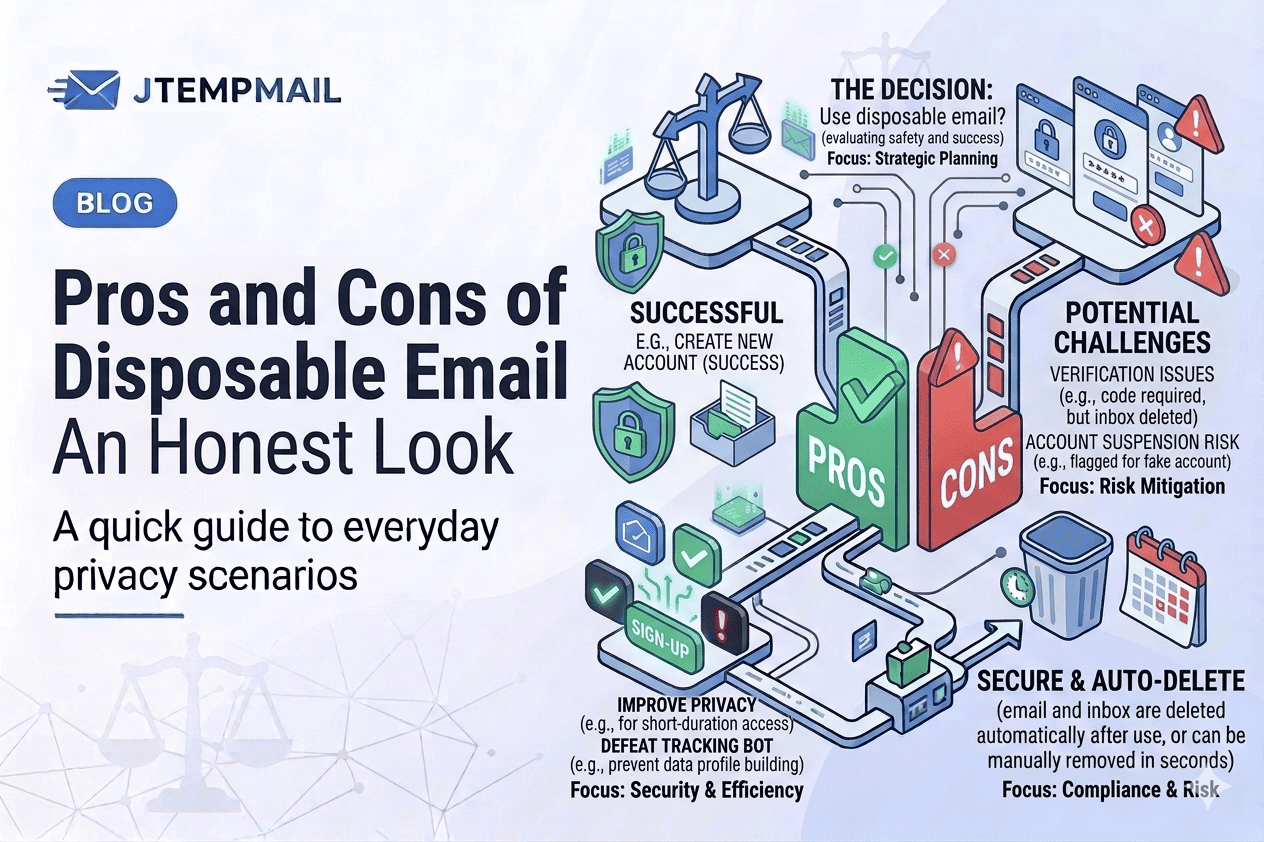
Pros and Cons of Disposable Email – An Honest Look
Let's be real for a minute
Every tool has its strengths and weaknesses. A hammer is great for nails, terrible for screws. Same thing with temporary email.
I could sit here and tell you disposable email is perfect for everything. But that wouldn't be honest. And honesty is what you're here for, right?
So let me give you a balanced, real-world look at the pros and cons of using temporary email. No hype. No fear-mongering. Just the truth.
The Pros – Why people love temporary email
1. Zero spam in your real inbox
This is the big one. Every time you use a temporary email for a signup or download, that's one less place your real address can be sold, shared, or hacked. Your personal inbox stays clean. No unsubscribe buttons. No junk folders to check.
2. No registration required
Most temporary email services – including jtempmail.com – don't ask you to sign up for anything. No passwords to remember. No "forgot password" emails. Just open and use.
3. Complete anonymity
The website you're signing up for gets an address. That's it. No name. No location. No connection to your real identity. You stay invisible.
4. Automatically disappears
You don't have to remember to delete anything. When the time runs out, everything is gone. No cleanup. No hassle.
5. Perfect for testing
If you're a developer, designer, or just curious, temporary emails let you test signup flows, verification systems, and trial offers without cluttering your real inbox with test data.
6. It's free
No credit card. No subscription. No "premium tier" hiding basic features. Just free.
The Cons – What you should know
1. Not for important accounts
This is the most important one. Never use a temporary email for your bank, your online shopping accounts, password recovery, or anything you'd be sad to lose access to. Those need a real, permanent email.
2. Some websites block them
Big platforms like Facebook, Instagram, and many banking sites have learned to detect temporary email domains. Sometimes they'll block you immediately. Other times they'll let you sign up but lock your account later.
3. You can't send emails
Most temporary email services are receive-only. That means you can't reply to messages or send anything from your temporary address. It's a one-way street.
4. Short lifespan
A temporary email usually lasts anywhere from 10 minutes to a few hours. That's plenty of time for most tasks, but if you need an address for days or weeks, this isn't the right tool.
5. No recovery if you lose access
Once a temporary email expires, it's gone forever. No customer support to call. No "forgot password" option. If you used it for something important, you're out of luck.
Quick comparison
| Situation | Use temporary email? | Why |
|---|---|---|
| Signing up for a newsletter | ✅ Yes | Keeps spam away |
| Downloading a free ebook | ✅ Yes | One-time use |
| Testing a new app | ✅ Yes | No commitment |
| Online banking | ❌ No | Need permanent access |
| Social media main account | ❌ No | Risk of losing access |
| Password recovery email | ❌ No | You might need it later |
| Forum you'll visit once | ✅ Yes | Perfect use case |
The bottom line
Temporary email is a fantastic tool – when you use it for the right things.
Think of it like a disposable camera. Great for quick snapshots. Terrible for your wedding photos.
Use it for low-stakes, one-time interactions. Keep your real email for the important stuff.
That's not a weakness of temporary email. That's just using the right tool for the right job.
At jtempmail.com, we're honest about what our service can and can't do. It's free. It's fast. It keeps your inbox clean. But it's not for everything – and that's okay.